


The wood wide web was coined and discovered by Dr. Suzanne Simard in 1990. It is the intricate process of how trees talk and help each other through this vast network. More specifically, it is a complex underground web of roots and mycorrhizal fungi. These connect trees and other plants to one another.
“At the time, lots of people in forestry were looking at how trees compete for light. I got more and more interested in what was going on below ground. I figured out that was where the action was.” - Dr. Suzanne Simard, forest ecologist from the University of British Columbia.
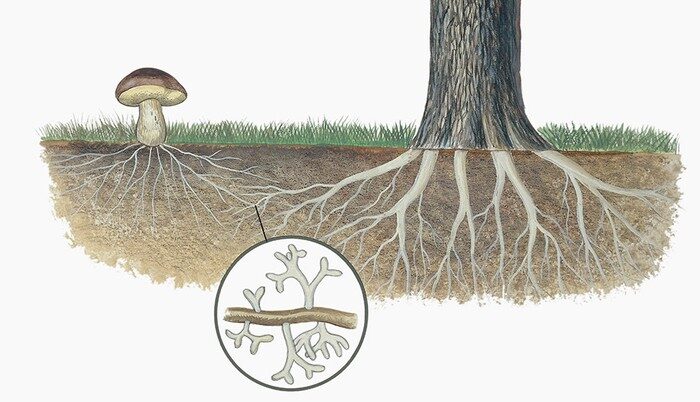
The wood wide web is 500 million years old and connects an estimated 90% of land plants.
The wood wide web is a collaborative relationship between plants and mycorrhizal fungi. Plants provide carbon-rich sugars made by photosynthesis and share them with the fungi. In return the trees are given nutrients, such as phosphorus and nitrogen. As the fungal threads grow and spread, they link up the plants around them. This creates a network. Through these networks, plants are able to exchange sugars, nutrients, water and more.
Simard also identified a 'mother tree'. These trees are normally the largest in the forest and act as hubs. A mother tree supplies seedlings with nutrients they need to grow. It uses this network of helpful fungi. But the wood wide web isn't just about sharing useful nutrients. It also allows plants to share signals. When a plant has an infestation, it can use this underground web to send a signal. Neighbouring plants can then raise their defences.
Page 7, OKIDO magazine #111 Trees.
"The revelation of the Wood Wide Web’s existence, and the increased understanding of its functions, raises big questions. These questions concern where species begin and end. They ask whether a forest might be better imagined as a single superorganism. This contrasts with viewing it as a grouping of independent individualistic ones. They also ask what trading, sharing, or even friendship might mean among plants." - The Secrets of the Wood Wide Web, The New Yorker.
Learn why leaves change colour with Zim, Zam and Zoom. Explore tree bathing with Messy. Create a flapping owl. Make a log cake, plus loads more with OKIDO.
OKIDO has a BRAND NEW app to make learning with OKIDO even more fun! This digital companion to your magazine brings new extra, interactive content every month to help bring the topic to life.Find out more here.

